Old letters
Recently I handed Annie a letter entitled “To my future wife.” In my awkward thirteen-year-old cursive I had written:
“I don’t know who you are or what you look like. Why will you not come to me and identify yourself?
Are you now a giggly 7th grader, barely old enough to wear a bra? Where do you live? In Ill. or New York? Do I know you already? Maybe I have seen you by chance on the street downtown. You meant nothing to me then. In the future you will mean everything to me.
What are you doing now, my wife-to-be? Are you going out with another? I am already jealous. What is your school like? What are your friends like? I will tell you about mine when you ask.
I would like to see your room, your books, your closet. What kind of clothes do you wear? What are you thinking right this instant? Please answer me. I want to know, for it will be important to me someday. I will love you someday.
I will save this for you. When I finally meet you, and fall in love with you, and marry you, then my questions will be answered.”
Well, as promised I did save it. And presented it to Annie, 41 years after we were married. She was amused but, disappointingly, couldn’t answer all my questions.
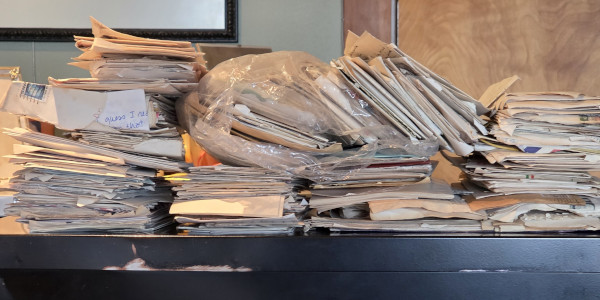
This was one of the first to surface in a horrifying horde of letters that I unearthed in my office. The disinterment was part of the painful process of clearing everything out in order to replace the ancient, fraying carpet that is almost as old as the letter to my future wife. Congealed in this musty collection of letters and cards were hundreds, maybe thousands, of hours of people’s lives spent telling me their news: their comings and goings and disappointments and longings and passions. Many were more than a half-century old. Email and texting were of course still a long way off, so most were written by hand. Others were typed, marked by the quaint presence of occasional crossovers or, with the more fastidious writers, white outs. In virtually all cases at the top of the letter was written only a day and a month; clearly almost none were composed with posterity in mind. The lack of a year made it frustratingly difficult to place certain letters in time.
I sat on that old worn carpet and grabbed random envelopes from the menacing piles. In some cases I had absolutely no memory of who the letter writer was, though often those letters were four or six pages long and mentioned people I well-remembered. Other writers I clearly recalled, but hadn’t thought about in years. And of course many letters were from people with whom I’m still in close touch. But these ancient communications made me feel I was seeing them through a distorting time warp. And, inevitably, some lively letters were from people who were no longer living.
The contents were as varied as the handwriting. Some were poignant, some trivial, some contained beautiful descriptions, and some were disturbing. Others were simply boring–reading about a long-lost friend’s car troubles some fifty years ago wasn’t exactly riveting. Mercifully, a few evoked happy memories, and some even made me laugh. But there were so many to read!
Confronted with piles and piles of these ancient letters, I was soon paralyzed. It made me queasy to contemplate devoting days on end going through them all. Part of me wanted nothing more than to chuck them all into the recycle bin—if I’d lived without reading them for decades, I could certainly do so forever. So I asked myself some questions about how I should proceed.
Question number 1: What could I possibly read that would make me really happy that I’d kept the letter? A precious but forgotten memory? A great story? A painful time that had been subsequently overcome? Sure! But even if, say, one in twenty letters was wonderful to unearth would that make it worth my while to read the other nineteen? Particularly since some of them could resurrect all sorts of negative feelings: nostalgia for no longer being young, sadness for losing touch with people who were once important in my life, anxiety at reliving disagreements or difficulties with old friends, and the pain of breakups with girlfriends who didn’t turn out to be my future wife.
Question number 2: if I chose to hang on to the unread letters because I’d be too uncomfortable trashing them, I’d store the pile away and, realistically, never get around to reading them. Then, after I pass, my kids, being practical and not overly sentimental, will probably toss them straight into the recycle bin. So wouldn’t it make sense for me to proactively throw them away and get it over with? A few less things for the heirs to deal with.
Question number three: I’m now facing what many of us face, at least those of us who didn’t grow up in the email/texting/social media era. When enormous stashes of letters and other documents are unearthed, what advice can I give others who find themselves in my situation? Hmm… Here are some suggestions:
1. Steadfastly resist the temptation to read every single letter. After all, even if they are still alive the writer will never know whether or not you re-read their letter decades after they popped it into the mailbox.
2. Cultivate a sense of liberation with every handful of letters you are able to grab and convey to the recycle bin without even bothering to determine who they are from.
3. If you come across a very special letter you really want to hold on to, scan it into your computer, then chuck the original. Electronic copies take up far less space than paper ones! And are more easily disposed of by the heirs.
4. Save the actual originals of only a very, very few. The single example in that category that I’ve come across so far is my letter to my future wife.
Question number 4: Why do I find it so hard to follow my own good advice?